How Can Queen Bee Nose Thread Lift Safely Correct Your Nasal Line Without Surgery?
What is the Anatomical Basis for Queen Bee Nose Thread Correction?
To understand the clinical effectiveness of the Queen Bee nose thread lift, one must look at the unique anatomy of the human nose. The nose is a complex structural combination of the nasal bone, upper lateral cartilage, lower lateral cartilage, and the septal cartilage. Unlike dermal fillers, which simply add volume to the soft tissue, thread lift procedures function as mechanical scaffolds. A nose thread lift is a minimally invasive treatment defined as the insertion of absorbable, cogged sutures into the nasal SMAS (superficial musculoaponeurotic system) and along the columellar pathway to achieve immediate structural projection and tissue approximation. This process relies on mechanical vector tension, pulling drooping tissue upward and aligning deviations along the nasal bridge.
For patients seeking nasal line correction, conservative and non-surgical management represents an important first step. For instance, temporary cosmetic adjustments or simple observation are highly reasonable when the structural asymmetry is minor—specifically, when nasal tip drooping or bridge deviation is less than 2 millimeters and does not present functional airway obstruction. However, when patients desire long-lasting structural correction without undergoing invasive open rhinoplasty, advanced biocompatible threads provide an optimal alternative. This treatment bridges the gap between temporary soft-tissue volumizers and permanent, high-risk surgical intervention.
Treatment timing: Best pursued when the nasal tip begins to droop or when localized contour depressions along the bridge require structural alignment, provided there is no active localized skin infection.
Non-surgical care: Conservative management is highly reasonable when contour irregularities are negligible and the patient has no history of multiple vascular complications from previous dermal treatments.
Treatment selection: The clinical choice depends strictly on the patient’s individual soft tissue thickness, cartilaginous support, and the specific vector force required to achieve a natural, balanced nasolabial angle.
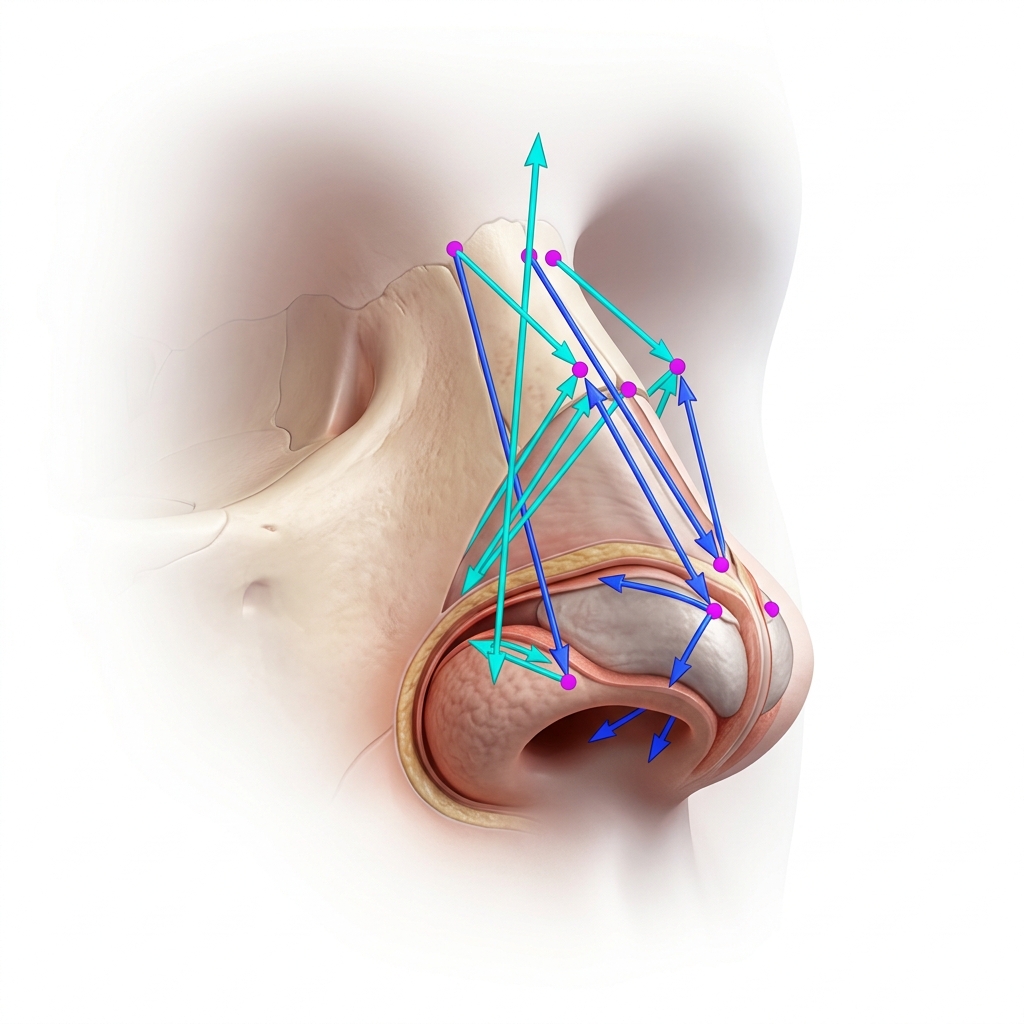
How Does Queen Bee Nose Thread Lift Compare to Fillers and Rhinoplasty?
Choosing the correct modality for nasal enhancement requires a detailed comparison of clinical mechanisms, longevity, and patient-specific risks. Traditional hyaluronic acid fillers are excellent for volumizing, but they carry a distinct risk of lateral spreading over time, which can broaden the nasal bridge—often referred to as the ‘avatar nose’ effect. Furthermore, dermal fillers carry a rare but severe risk of vascular compromise or skin necrosis if the product is inadvertently injected into the angular or dorsal nasal arteries. In contrast, Queen Bee threads are solid structures, completely eliminating the risk of vascular gel migration.
According to multiple observational studies and meta-analyses published in the *Aesthetic Surgery Journal* (2021), PCL (Polycaprolactone) and PDO (Polydioxanone) threads demonstrate high structural safety, maintaining their mechanical integrity for 12 to 24 months. Over this period, they undergo progressive biodegradation while stimulating endogenous type I and type III collagen synthesis, creating a natural tissue scaffold. However, outcomes may differ in exceptional cases, such as patients with severe nasal septal cartilage deviations, active autoimmune conditions, or extensive scar tissue from a previous open rhinoplasty, where surgical reconstruction remains the definitive path.
| Clinical Parameter | Queen Bee Thread Lift | Hyaluronic Acid Filler | Surgical Rhinoplasty |
|---|---|---|---|
| Primary Mechanism | Physical scaffolding & vector tension | Fluid volume expansion | Cartilage/bone remodeling |
| Average Longevity | 12 to 24 months (collagen-forming) | 6 to 12 months (degrades faster) | Permanent (highly invasive) |
| Key Limitation | Limited correction for extreme humps | Risk of vascular compression | High downtime & irreversible structure |
According to official guidelines or academic evidence, both quantitative criteria and clinical judgment should be reviewed together.
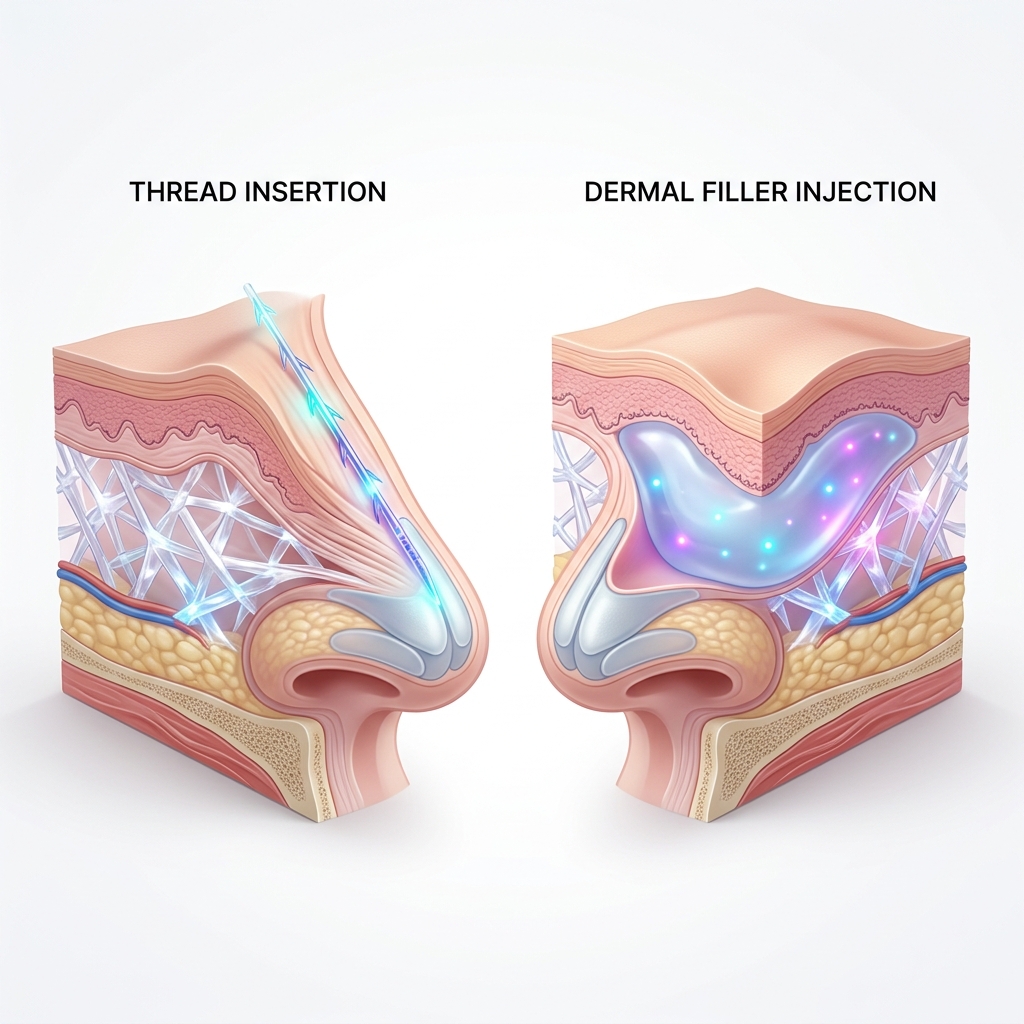
Who is the Best Candidate for This Non-Surgical Nasal Correction?
To achieve optimal and safe outcomes, patients must meet specific clinical criteria. A thorough physical evaluation is essential to assess skin elasticity, soft tissue thickness, and the strength of the underlying lower lateral cartilages. A candidate must understand both the capabilities and the physical boundaries of thread-based correction before proceeding.
- Nasal Tip Laxity: Individuals with a drooping nasal tip who have adequate septal cartilage support to anchor the vertical threads.
- Moderate Bridge Contouring: Patients with a mild dorsal hump or a flat nasal bridge requiring structured, linear definition.
- High Biocompatibility Needs: Patients seeking materials that naturally degrade and leave no permanent synthetic residue.
- Prior Filler Dilution: Patients who have experienced spreading from previous filler injections and wish to restore a sharp, defined nasal profile.
To guide clinical decisions, a structured 3-step evaluation protocol is applied during the diagnostic phase:
- If the patient has thin skin with a pronounced bony hump, then soft-tissue modification with threads alone is limited; a surgical consultation or combined minor conservative management may be required.
- If the patient presents with a blunt nasolabial angle (less than 90 degrees), then inserting rigid PCL threads into the columellar pillar is indicated to lift the nasal tip.
- If there is a history of recent nasal infection or systemic inflammation, then the procedure must be deferred until complete physiological resolution is confirmed.
Frequently Asked Questions FAQ
QIs there a high risk of thread protrusion or extrusion through the skin?
With correct technique and premium materials, the risk of extrusion is extremely low. Protrusion typically occurs only if the threads are placed too superficially or under excessive structural tension. Choosing highly flexible materials like PCL and utilizing a precise aseptic multi-layer approach dramatically minimizes these complications.
QWhat is the typical downtime and recovery protocol after the procedure?
Most patients experience mild swelling, localized tenderness, and minimal bruising for 3 to 7 days. It is recommended to avoid heavy physical exertion, facial massages, and sleeping face-down for at least 14 days to allow the cogs to integrate firmly into the tissue.
QCan this procedure correct functional septal deviations?
No, Queen Bee thread lifts are strictly cosmetic procedures designed to refine external contours, such as the nasal bridge and columella. Structural airway obstructions or breathing difficulties must be addressed through functional rhinoplasty or septoplasty performed by an otolaryngologist.

This content is general medical information, and individual treatment decisions should be made through imaging tests and in-person medical evaluation.
Author: Medical content editor based on medical information research
Reviewed by: Specialist consultation from the relevant department
Last reviewed: 2026-06-25
Reference guideline: 2023 International Society of Aesthetic Plastic Surgery (ISAPS) Guidelines
Medical neutrality and closing note
The core of medical decision-making is not to follow a specific device or a trending procedure, but to choose an option that fits each patient’s individual anatomy, condition, risk level, and treatment goals. Every procedure has both advantages and limitations, so decisions should be made after sufficient discussion with an experienced specialist.
[Medical information and copyright notice]
This content is a professional medical column prepared based on medical consultation from 청담큐비큐의원.
The infographics used in this article are created to support understanding and may differ from actual clinical results.
The information provided is a general medical guideline, and accurate diagnosis and treatment require an in-person evaluation by a qualified specialist.