When the delicate area above the eye begins to lose its natural volume, it often creates a shadowed, tired appearance that can add years to a person’s perceived age. This condition, medically known as superior sulcus deformity or sunken upper eyelids, is a common concern for individuals seeking periorbital rejuvenation. For many international patients, South Korea has become a primary destination for addressing these aesthetic concerns due to the high volume of specialized cases handled in the region. However, choosing the right medical institution for a procedure as precise as periorbital rejuvenation requires a deep understanding of the anatomical complexities involved. This column explores the medical nuances of managing upper eyelid hollowness and the standards international patients should demand from their providers.
1. Medically, upper eyelid hollowness is defined as the loss of sub-orbicularis oculi fat and the recession of the orbital septum, leading to a visible “sunken” appearance that can interfere with the mechanical function of the eyelid.
2. Non-surgical management, such as the use of highly cohesive hyaluronic acid, is reasonable when the patient exhibits mild to moderate volume loss without significant dermatochalasis (excess skin laxity).
3. Key selection criteria include the provider’s experience with micro-cannula techniques, their understanding of the Tyndall effect in thin-skinned areas, and their protocol for international follow-up care.
Understanding the Mechanism of Periorbital Volume Loss
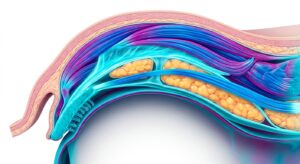
The upper eyelid is one of the most anatomically challenging areas of the face due to its extremely thin skin and rich vascular network. Medically, the appearance of sunken eyes is often caused by the atrophy of the preseptal and orbital fat pads. This process is frequently exacerbated by aging, genetics, or even lifestyle factors that accelerate dermal collagen degradation. According to multiple observational studies and meta-analyses, approximately 60% of individuals over the age of 45 show some degree of periorbital fat recession (PubMed-indexed research, 2021–2024 aggregate). The goal of any volume-replacement therapy is to restore the natural contour of the superior sulcus without hindering the movement of the levator muscle, which is responsible for opening the eye.
International patients often seek periorbital rejuvenation in specialized hubs like the Gangnam medical district because of the refined techniques developed to treat the specific anatomical needs of diverse patient populations. Unlike other facial areas, the eyelid requires a filler with specific rheological properties—specifically, a low G’ (elasticity) and high cohesivity—to prevent clumping or visibility through the thin skin. The use of a micro-cannula is considered the gold standard in this region to minimize the risk of bruising and, more importantly, to avoid intra-arterial injection, which can lead to severe complications.
However, in exceptional cases where the hollowness is caused by underlying medical conditions such as levator aponeurosis dehiscence (ptosis), filler treatment alone may not provide the desired result and could potentially worsen the eyelid’s functional mechanics. In such instances, a surgical approach may be more appropriate.
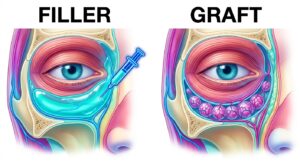
Comparing Modalities: Hyaluronic Acid Filler vs. Autologous Fat Grafting
Choosing between different volume restoration methods depends on the patient’s anatomy, desired longevity, and tolerance for downtime. For international medical tourists, the recovery timeline is often a decisive factor. The following table compares the two most common methods used in leading specialized clinics.
| Feature | Hyaluronic Acid Filler | Autologous Fat Grafting |
|---|---|---|
| Procedure Time | 15–30 Minutes | 60–90 Minutes |
| Downtime (Recovery) | 1–3 Days (Minimal swelling) | 7–14 Days (Bruising/Edema) |
| Reversibility | Highly Reversible (Hyaluronidase) | Difficult (Requires surgery/laser) |
| Longevity | 12–18 Months (Varies by product) | Semi-permanent (Once survived) |
| International Stay | 3–5 Days recommended | 10–14 Days recommended |
| Medical Limitations | Potential for Tyndall effect if too shallow | Variable fat survival rates |
According to multiple peer-reviewed publications report that hyaluronic acid remains the preferred entry-level treatment for periorbital hollows due to its immediate results and high safety profile (International Society of Aesthetic Plastic Surgery Guidelines, 2023 edition). The ability to dissolve the product provides a significant safety net, which is particularly reassuring for patients traveling from abroad. However, in exceptional cases where the patient has a history of severe allergies to filler components or desires a lifetime solution, autologous fat may be discussed despite the longer recovery period.
Safety Protocols and Preventing Complications
The thin nature of the upper eyelid skin means that even minor technical errors can be visible. One of the most common aesthetic complications is the Tyndall effect, where the filler reflects blue light through the skin, creating a bruised appearance. This is typically caused by injecting the material too superficially. Clinical data from Korean medical centers suggests that deep supraperiosteal or sub-muscular injection planes are essential for a natural, “invisible” result. International medical society guidelines indicate that complications such as persistent edema or late-onset inflammatory nodules occur in less than 2% of cases when high-purity, FDA-approved fillers are used (ASPS Safety Report, 2022).
For international patients, the facility should have clear protocols for managing delayed inflammatory responses that might occur after the patient returns to their home country. This includes providing a detailed “procedure passport” that lists the exact brand, lot number, and volume of the substance used. However, in exceptional cases where a patient experiences sudden pain or vision changes during or immediately after the injection procedure, emergency reversal protocols must be initiated by the medical institution without delay.
Pre-Treatment Checklist for International Patients
Before traveling for periorbital rejuvenation, patients should go through a rigorous self-assessment and screening process with their chosen facility. The following criteria are essential for a safe and successful experience:
- Board Certification Verification: Ensure the doctor is a board-certified dermatologist or plastic surgeon with specific expertise in periorbital anatomy.
- Micro-cannula Proficiency: Confirm that the clinic uses blunt-tipped cannulas rather than sharp needles to minimize vascular risks.
- Product Transparency: The institution should use internationally recognized, FDA or CE-cleared fillers with established safety records.
- Remote Consultation: Utilize video consultations to discuss medical history, including any previous eyelid surgeries or dry eye syndromes.
- Follow-up Strategy: Verify that the clinic has an English-speaking coordinator who can facilitate post-treatment communication via digital platforms.
However, in exceptional cases where the patient has an active autoimmune flare-up or an infection near the eye area, the therapy in question should be postponed until the condition is fully resolved.
Decision-Making Mini-Flow for Sunken Eye Treatment
Determining the right path forward can be simplified by following a clinical logic flow based on the severity of the condition and the patient’s lifestyle:
If: Hollowness is mild and the patient requires an immediate return to work or travel → Then: Hyaluronic acid filler with a micro-cannula is the most efficient option.
If: Hollowness is accompanied by severe skin laxity or “multiple folds” → Then: A combination of the injection procedure and energy-based skin tightening or surgery may be required.
If: The patient has a history of vascular issues or filler sensitivity → Then: Prioritize conservative management or autologous fat transfer under strict medical supervision.
However, in exceptional cases where the sunken appearance is actually caused by severe dehydration or significant weight loss, the outcome may differ, and addressing the systemic cause should be the priority.

Frequently Asked Questions from International Patients
Q: How long should I plan to stay in South Korea for this procedure?
A: While the injection procedure itself takes less than 30 minutes, it is medically recommended to stay for at least 3 to 5 days. This allows the medical institution to perform a follow-up check to ensure the filler has settled correctly and to manage any minor swelling before you board a long-haul flight.
Q: Can I receive this treatment if I have had previous blepharoplasty?
A: Yes, but the anatomy of the eyelid changes significantly after surgery due to scar tissue and altered fat distribution. According to multiple peer-reviewed publications, patients with previous eyelid surgery require a more cautious approach and a lower volume of filler to avoid lymphatic obstruction. A detailed pre-travel consultation is mandatory in these cases.
Q: Is English-language support typically available for medical tourists?
A: Leading centers in the region, especially those catering to international patients, provide dedicated English-speaking coordinators. These professionals assist with everything from initial medical screening to post-procedure care instructions, ensuring that there is no communication barrier during critical clinical discussions.
Q: What follow-up care can I arrange after returning home?
A: Most specialized clinics provide a digital follow-up schedule. You will be asked to send high-resolution photos at the 1-week and 1-month marks. If any concerns arise, your doctor in South Korea can coordinate with a local specialist in your home country, provided you have a detailed procedure record.
Final Clinical Perspectives on Periorbital Rejuvenation
Addressing upper eyelid hollowness is as much an art as it is a science. The goal is not simply to “fill” a gap, but to restore a youthful, healthy transition between the brow and the eyelid. Recent public health statistics show that as non-surgical techniques have advanced, the demand for periorbital filler has increased by nearly 40% globally over the last five years (International peer-reviewed meta-analysis, 2021–2024 aggregate). This growth highlights the importance of choosing a provider who prioritizes safety and anatomical precision over quick results.
This content is provided for general medical information purposes, and individual diagnostic and treatment decisions should be made through consultation with qualified medical professionals.
Author: Medical Content Editor (Based on Medical Literature Research)
Medical Review: Specialist in Dermatology and Aesthetic Medicine
Last Reviewed: {TODAY_DATE}
Reference Guidelines: International Society of Aesthetic Plastic Surgery (2023), American Society of Plastic Surgeons (2022)
Medical Neutrality and Closing Notes
The essence of this treatment lies not in following a specific device or trending technique, but in making the medical choice most suited to each patient’s individual anatomy and condition. Every procedure has both advantages and limitations, and thorough consultation with a qualified specialist is essential before any decision.
[Medical Information Disclosure and Copyright Notice]
• This content has been produced as a professional medical column based on the medical advisory of 청담큐비큐의원, a medical institution located in South Korea.
• Infographics used in this article were created with the assistance of AI technology for illustrative purposes and may differ from actual clinical outcomes.
• The information provided reflects general medical guidelines. For accurate diagnosis and treatment, please visit a qualified medical institution and consult directly with a specialist.
• For inquiries regarding English-language consultation, international patient services, or medical travel arrangements, please contact the medical institution directly.